
What to do in the first 48 hours after a concussion
Understanding the first 48 hours after a concussion is critical for recovery.
Definition
A concussion is a type of head injury that can result from a forceful impact to the head, neck, or body, which causes the brain to move within the skull.
The first 48 hours after a concussion can significantly impact recovery.
Signs and Symptoms of a Concussion
Recognising concussion can be difficult. It is important to know when to suspect a concussion, because appropriate response and management can help prevent further injury or even death. There are several possible symptoms and signs, but they can be subtle and are not specific to a concussion.
In the first 48 hours after a concussion, monitoring symptoms is essential.
It is important to remember not just athletes may get a concussion. A fall off a ladder or a car accident may cause a force to the head.
A concussion should be suspected when an injury results in a knock to the head or body that transmits a force to the head. A hard knock is not required—a concussion can occur from minor knocks.
Use the Concussion Recognition Tool 6 to help you recognise a concussion.
The signs of concussion vary and may be difficult to detect.
| Critical symptoms/signs | Obvious symptoms/signs | Subtle symptoms/signs |
| · Neck pain · Increasing confusion, agitation or irritability · Repeated vomiting · Seizure or convulsion · Weakness or tingling/burning in the arms or legs · Deteriorating conscious state · Severe or increasing headache · Unusual behavioural change · Double vision |
· Loss of consciousness · No protective action in a fall to ground directly observed or on video · Seizure or jerky movements after a knock · Confusion, disorientation · Memory impairment · Unsteady on feet or balance problems · Athlete reports significant, new or progressive concussion symptoms · Dazed or looking blank/vacant · Changed behaviour – may be more irritable, agitated, anxious or emotional than normal |
· Headache · ‘Pressure in the head’ · Neck pain · Nausea or vomiting · Dizziness · Blurred vision · Balance problems · Sensitivity to light · Sensitivity to noise · Feeling slowed down · Feeling like ‘in a fog’ · ‘Don’t feel right’ · Difficulty concentrating · Difficulty remembering · Fatigue or low energy · Confusion · Drowsiness · More emotional · Irritability · Sadness · Nervous or anxious · Trouble falling asleep (if applicable) |
Some people find it hard to describe their symptoms. They may report not ‘feeling right’
What to do within the first 48 hours after a concussion?
While all concussions should be assessed by a doctor, most will resolve without the need for specific treatment. A short period (24-48 hours) of relative rest, followed by gradual return to activity, is the main treatment.
To help your recovery after a concussion, you should:
-
- Contact a GP for diagnosis and symptom management
- Rest and maintain a normal sleeping schedule
- Avoid screens in the first 48 hours after a concussion to aid recovery.
- Gradually increase physical activity as recommended by a physiotherapist.
- Begin with light exercise for 20 minutes
- Speak to your GP or physiotherapist for a guide to return to exercise, school and work.
- Do not consume alcohol, anti-inflammatories, take sleeping pills or use recreational drugs for 48 hours.
| NOTE: Any athlete with a suspected concussion should be IMMEDIATELY REMOVED FROM PRACTICE OR PLAY and should NOT RETURN TO ANY ACTIVITY WITH RISK OF HEAD CONTACT, FALL OR COLLISION, including SPORT ACTIVITY, until ASSESSED MEDICALLY, even if symptoms resolve.
Athletes with suspected concussion should NOT: · Be left alone initially (at least for the first 3 hours). Worsening of symptoms should lead to immediate medical attention. In the first 48 hours after a concussion, having someone monitor you is advised. Concussion Recognition Tool 6 2023
|
How can a physiotherapist help?
A medical practitioner must diagnose a concussion. A physiotherapist can assess a client and deem they will need a referral to be diagnosed by a medical professional via the symptoms they are experiencing.
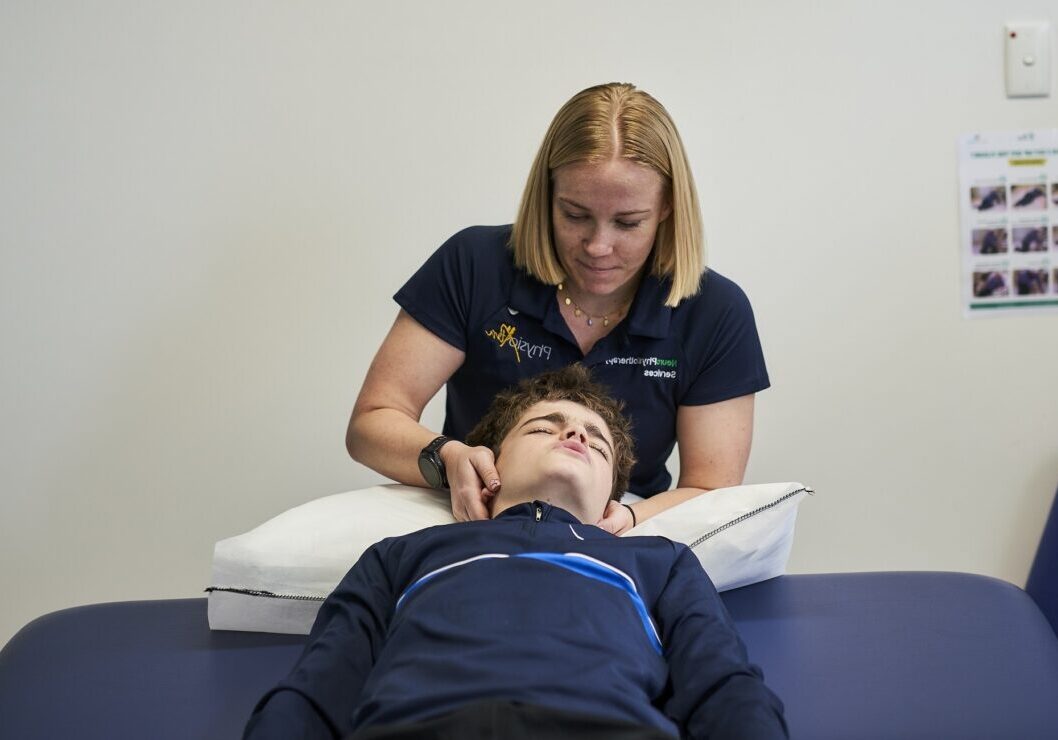
A physiotherapist can assist with concussion management during a physiotherapy appointment, including:
- Symptom management – treatment of neck pain/stiffness, dizziness, headache
- Education and advice
- Return to work and school advice – gradual return to their usual program at school or work
- Exercise prescription for recovery and reduction of symptoms
- Monitoring progress
- Screening baselines for prevention
- Return to exercise planning – gradual return to full sporting activity
A physiotherapy appointment will consist of assessing the cause of the concussion symptoms, which can vary from the cervical spine, vestibular or oculomotor system impairments. The discrepancies will be treated, and most often, a home exercise program and education will help the client improve at home.
A tailored plan should be implemented in the first 48 hours after a concussion.
Appropriate management, including cervical and VOM rehabilitation, supports a more complete recovery. The Interdisciplinary care flow chart for athletes with concussion helps guide health practitioners through an appropriate system for managing athletes with concussion.
Follow-up assessments in the first 48 hours after a concussion are recommended.
It is recommended that a return to all aspects of life approach be used when rehabilitating an athlete post-concussion. This ensures that the five domains, i.e., physical, cognitive, emotional, fatigue and sleep, are targeted appropriately.
‘Return to sport’
‘Return to sport’ is about the athlete’s gradual return to full sporting activity and a physiotherapist is well placed to guide this process.
Having rested for 24 – 48 hours after sustaining a concussion, the patient can begin light intensity physical activity – as long as the activity doesn’t cause significant and sustained deterioration in symptoms.
The Graded Return to Sport Framework (GRTSF) requires those aged 18 or under to be symptom-free for 14 days before medical clearance to return to contact or high-risk activity. To be clear, that is 14 days from when the athlete becomes symptom-free. It ensures that the most vulnerable individuals have demonstrated a clear capacity to perform all normal activities of daily living, including non-contact exercise, without symptoms, before they return to the field of play.
It is important to note developments in the first 48 hours after a concussion.
‘Return to work or learn’
‘Return to learn’ is about the client’s gradual return to their usual program at school or work.
Ensure that adaptations are made in the first 48 hours after a concussion.
A graded return to learn and return to sport should occur concurrently. Activities that do no exacerbate symptoms should be introduced first and may be related to either their return to school or sport.
Physiotherapists can use Return to Learn or Work Plans to communicate to teachers or workplaces the requirements for a concussed client.
Further Resources
Resources are available to guide you in the first 48 hours after a concussion.
Below are some further resources which can help inform parents, teachers, coaches and athletes
HeadCheck app for sideline questioning
Use available tools to assess your condition in the first 48 hours after a concussion.
For sport-specific concussion policies, please click on the appropriate link:
Australian Football League (AFL)
Understand the protocols in the first 48 hours after a concussion for safety.
Australian Football Federation
Awareness of the first 48 hours after a concussion can enhance recovery outcomes.
